


 Deutsch
 English
 Español
 Français
 Nederlands
 Português


 Share
Share




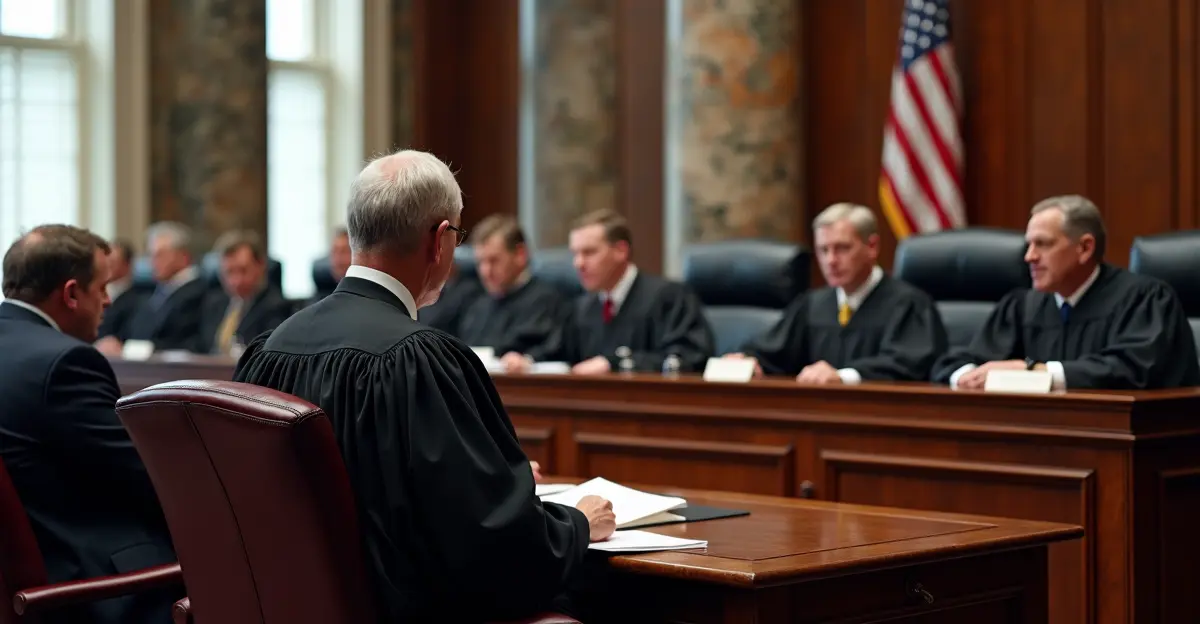
On February 20, 2026, the U.S. Supreme Court delivered a landmark 6-3 ruling in Learning Resources, Inc. v. Trump, striking down President Donald Trump's sweeping tariffs imposed under the International Emergency Economic Powers Act (IEEPA). Within hours, the administration reimposed levies under Section 122 of the Trade Act of 1974, triggering a new era of tariff volatility that has fundamentally reshaped global trade architecture. This analysis examines the strategic implications of the ruling and the permanent shift underway in international commerce.
The Ruling and Immediate Aftermath
Chief Justice John Roberts, writing for the majority, held that IEEPA 'contains no reference to tariffs or duties' and that no previous president had read the law to confer such authority. A plurality of justices found the tariffs violated the 'major questions' doctrine, requiring clear congressional delegation for economically significant executive actions. The decision vacated tariffs that had generated an estimated $200 billion in revenue since their imposition in 2025.
Justice Kavanaugh dissented, warning the ruling could create 'uncertainty regarding trade agreements' and potentially require billions in refunds. The court did not address refund mechanisms, leaving that to the Court of International Trade. Trade attorneys estimate importers could recover up to $175 billion, though the process may take years.
President Trump responded by invoking Section 122 of the Trade Act of 1974 — a rarely used authority — imposing a 10% global tariff effective February 24, 2026, for 150 days. The new Section 122 tariff framework exempts critical minerals, energy products, pharmaceuticals, and USMCA-compliant goods, but maintains broad coverage across most imports.
Fragmentation of Global Trade Into Competing Blocs
The ruling and rapid reimposition of tariffs have accelerated the fragmentation of global trade into competing geopolitical blocs. According to the McKinsey Global Institute's 2026 update, the world is moving away from hyper-globalization toward a multipolar system where alliances and security concerns dictate trade relationships.
China's Strategic Adaptation
China, which saw its trade-weighted tariff rate drop 7.1 percentage points under the new Section 122 regime compared to IEEPA levels, has demanded full reversal of U.S. levies. However, Beijing is also deepening South-South trade corridors, which now account for 57% of developing-country exports, bypassing traditional Western hubs. UNCTAD data shows South-South trade reached $6.8 trillion in 2025, a trend accelerating in 2026.
European Union Response
The European Commission has demanded 'full clarity' from Washington on trade commitments, noting that the EU's trade-weighted tariff rate increased by 0.8 percentage points under the new regime. The ECB projects that redirected Chinese exports could lower euro area inflation by up to 0.15 percentage points in 2026, as Chinese goods diverted from the U.S. market flow into Europe.
Global South Realignment
Developing economies face heightened compliance costs from the proliferation of trade measures — since 2020, approximately 18,000 new discriminatory trade measures have been introduced globally. However, the shift also presents opportunities as supply chains diversify away from traditional hubs. Countries like Vietnam, India, and Mexico have emerged as key beneficiaries of nearshoring trends.
From Just-in-Time to Just-in-Case: The Supply Chain Revolution
The Thomson Reuters 2026 Global Trade Report reveals that 76% of trade professionals believe the new tariffs represent a permanent shift in trade policy lasting at least four years. In response, 65% of companies are altering sourcing patterns, 57% are renegotiating supplier contracts, and 51% are pursuing nearshoring or reshoring strategies.
Supply chain concerns have nearly doubled year-over-year, with 68% of trade professionals identifying it as a top priority, up from 35%. The traditional 'just-in-time' model, focused on lean inventories and cost efficiency, is giving way to a 'just-in-case' approach that prioritizes resilience through higher stock levels and diversified suppliers.
Technology adoption is accelerating dramatically, with 40% of companies exploring AI or blockchain solutions for supply chain management — a nearly sevenfold increase from 6% in 2024. Trade departments have gained strategic influence, with 43% reporting enhanced procurement decision-making authority.
Geopolitical Fallout and the Contest Over Executive Tariff Power
The Supreme Court ruling has left executive tariff authority in a contested state. While IEEPA-based tariffs were struck down, the administration's immediate pivot to Section 122 demonstrates the ongoing contest over presidential trade powers. Legal scholars note that Section 122 authority is temporary (150 days) and capped at 15%, creating uncertainty beyond July 2026.
U.S. allies face surprising outcomes under the new regime. The United Kingdom's trade-weighted tariff rate increased by 2.1 percentage points, while Japan's rose 0.4 points and South Korea's 0.6 points. Meanwhile, countries previously hit hardest by IEEPA orders — including Brazil (13.6-point drop) and China (7.1-point drop) — saw sharp relief.
Global Trade Alert analysis indicates that nations which negotiated bilateral deals under the old IEEPA framework may be disadvantaged, while those that resisted are vindicated. Confusion persists as the White House fact sheet still lists 10% tariffs despite Trump's announcement of 15% duties, and the legal status of bilateral agreements remains uncertain under Section 122's non-discriminatory requirements.
Expert Perspectives
'This is the most consequential shift in U.S. trade authority in decades,' said Sarah Johnson, trade policy analyst at the Peterson Institute for International Economics. 'The ruling doesn't end tariff uncertainty — it transforms it. Companies now face a patchwork of authorities that can be activated or challenged, creating a permanent state of volatility.'
Michael Chen, supply chain director at a major electronics manufacturer, noted: 'We've moved from optimizing for cost to optimizing for resilience. Every sourcing decision now includes a geopolitical risk assessment. The just-in-case model is more expensive, but it's the only way to operate in this environment.'
FAQ: The Supreme Court Tariff Ruling
What did the Supreme Court rule on tariffs in 2026?
In Learning Resources, Inc. v. Trump, the Court ruled 6-3 that the International Emergency Economic Powers Act (IEEPA) does not authorize the president to impose tariffs, striking down the Trump administration's sweeping tariffs imposed under that statute.
What tariffs replaced the IEEPA tariffs?
Hours after the ruling, President Trump imposed a 10% global tariff under Section 122 of the Trade Act of 1974, effective February 24, 2026, for 150 days. The rate was later announced as 15% in some statements, creating confusion.
Will importers get refunds for tariffs already paid?
The Supreme Court did not address refunds. The Court of International Trade will oversee refund proceedings, which could take months or years. Importers who did not preserve their claims may forfeit refund rights. Estimates suggest up to $175 billion could be recovered.
How are supply chains changing in response?
Companies are shifting from 'just-in-time' to 'just-in-case' models, with 65% altering sourcing patterns, 51% pursuing nearshoring, and 40% adopting AI/blockchain for supply chain management. Supply chain resilience has overtaken cost efficiency as the primary corporate objective.
What does this mean for global trade in the long term?
Trade is fragmenting into competing geopolitical blocs, with South-South trade surging and traditional Western hubs losing dominance. 76% of trade professionals view tariff volatility as permanent, suggesting the post-2026 trade architecture will be defined by contested executive powers and resilience-focused supply chains.
Conclusion: A New Trade Architecture
The Supreme Court's February 2026 ruling marks an inflection point that redefines global commerce for the remainder of the decade. While the immediate legal question — whether IEEPA authorizes tariffs — has been answered, the broader contest over executive tariff power continues. The administration's pivot to Section 122 demonstrates that tariff volatility is not a temporary phenomenon but a structural feature of the new trade landscape.
For businesses, the message is clear: the era of predictable, rules-based global trade has given way to a fragmented, contested system where resilience is paramount. Companies that adapt to the 'just-in-case' paradigm and navigate the evolving geopolitical trade landscape will be best positioned to thrive in this new environment.




Follow Discussion